Zero Tolerance: Mastering Histamine Control for Premium Fishery Markets
By. Nugroho Luhur - 30 Jan 2026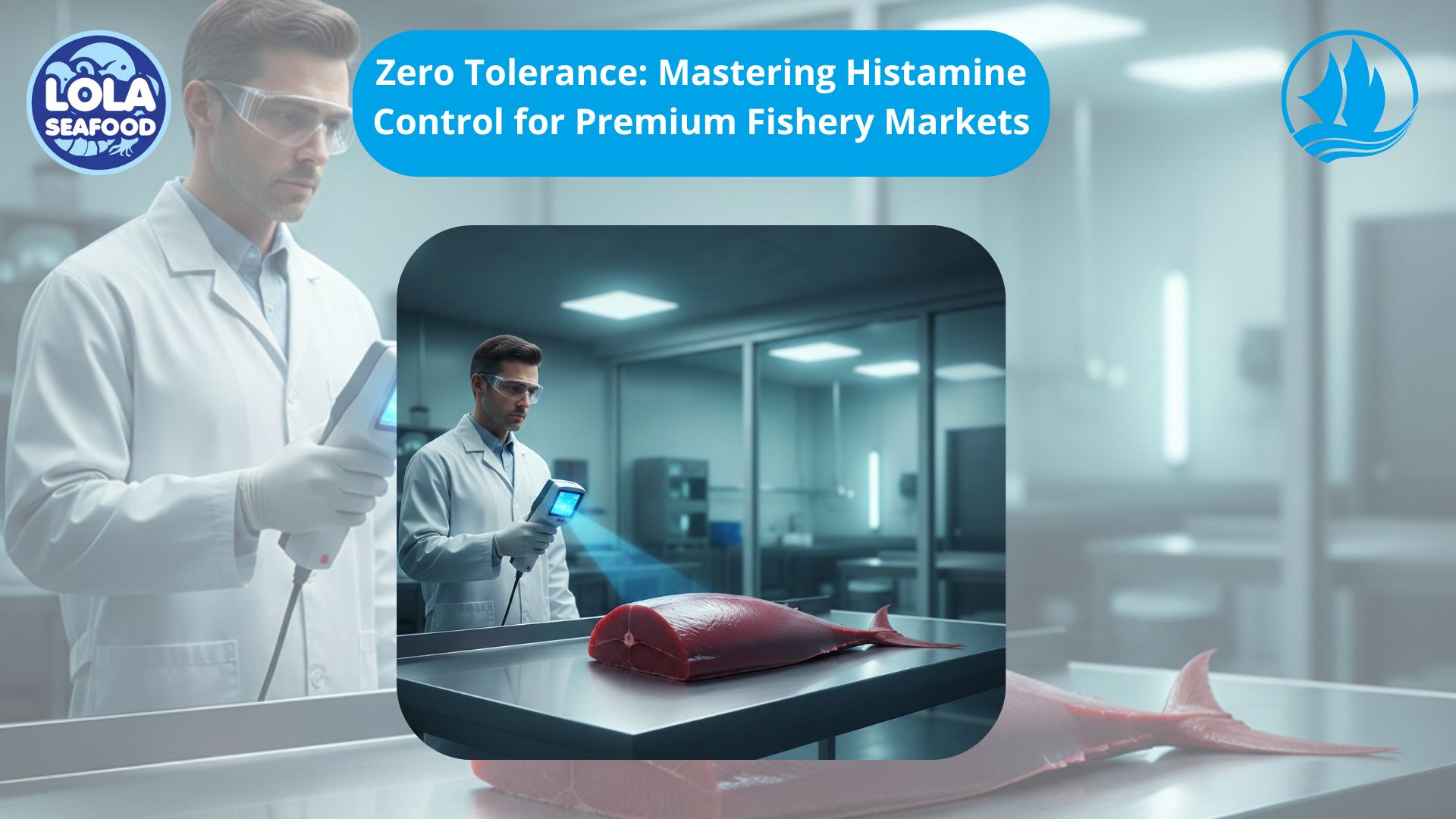
kelolalaut.com In the high-stakes world of global seafood exports, reputation is built on freshness, but survival is built on safety. For premium fishery markets—such as the European Union, the United States, and Japan—there is one chemical compound that acts as a definitive gatekeeper: Histamine. As a potent biogenic amine, histamine is the primary cause of scombroid poisoning, a foodborne illness that can trigger severe allergic reactions in consumers. For processing plants aiming for the "Premium" tier, managing histamine isn't just a quality preference; it is a "Zero Tolerance" mission.
The Science of the Invisible Threat
Unlike physical contaminants like fish bones or biological threats like parasites, histamine is an invisible, odorless, and heat-resistant chemical. It forms through the decarboxylation of the amino acid L-histidine, a process catalyzed by the enzyme histidine decarboxylase produced by certain bacteria (Proteus, Klebsiella, and Morganella).
The most significant challenge for any factory manager is that once histamine is formed, it cannot be removed. Cooking, canning, or freezing may kill the bacteria, but the histamine remains stable. Therefore, the "Zero Tolerance" philosophy focuses entirely on prevention through temperature and time.
The Foundation: Cold Chain Integrity
The cornerstone of histamine control is the Cold Chain. The formation of histamine is highly temperature-dependent. At temperatures above 21, bacteria can produce dangerous levels of histamine in as little as a few hours.
To master control, a premium processing plant must implement a "Rapid Chilling" protocol from the moment of harvest.
- At Sea: The internal temperature of the fish (especially species like Barramundi, Tuna, or Mackerel) must be brought down to 0C or below as quickly as possible using ice slurries or refrigerated seawater (RSW).
- Reception: Upon arrival at the factory, every batch must undergo a sensory evaluation and a core temperature check. Any fish arriving at temperatures above $4.4^\circ\text{C}$ ($40^\circ\text{F}$) should be flagged as high-risk.
- Processing: The "Time-Temperature" (T-T) budget is strictly monitored. A premium factory ensures that fish remain in the processing room (usually kept at $10^\circ\text{C}$ to $15^\circ\text{C}$) for the shortest duration possible before returning to cold storage.
Implementing HACCP with a Histamine Focus
A robust Hazard Analysis and Critical Control Point (HACCP) plan is the backbone of histamine mastery. In a premium facility, the following Critical Control Points (CCPs) are non-negotiable:
- CCP 1: Raw Material Receiving. This is the first line of defense. Factories must only source from vessels that provide validated temperature logs.
- CCP 2: Chilling/Refrigeration. Continuous monitoring of cold storage units using calibrated digital sensors. If a deviation occurs (e.g., a power failure), the system must trigger an immediate alarm.
- CCP 3: Processing Time. Implementing a "First-In, First-Out" (FIFO) system and tracking the "cumulative exposure time" to ambient temperatures.
Advanced Detection: Moving Beyond Sensory
While the "smell test" is a traditional tool, premium markets demand data-driven assurance. Modern processing plants utilize a tiered testing approach:
- Screening (ELISA Kits): Rapid, cost-effective enzyme-linked immunosorbent assays allow the lab to screen dozens of samples in under 30 minutes. This is ideal for routine daily monitoring.
- Verification (HPLC): High-Performance Liquid Chromatography provides the "Gold Standard" in accuracy. It can detect histamine at levels as low as $1\text{ ppm}$ to $5\text{ ppm}$. For premium exports, providing an HPLC-certified lab report with the shipment is a powerful mark of quality that builds buyer trust.
The "Premium" Edge: Traceability and Culture
Mastering histamine control requires more than just machinery; it requires a Food Safety Culture. Every worker on the floor must understand that a 30-minute delay in moving a bin of fish can compromise the safety of the entire lot.
Digital traceability systems now allow factories to tag each batch with a QR code. A buyer in New York or Brussels can scan that code and see the temperature history and the histamine test results of that specific fillet. This level of transparency is what separates a commodity supplier from a premium partner.
.jpg)

.jpg)
.jpg)
.jpg)
.jpg)