The Blue Carbon Revolution: Indonesia’s Strategic Leap Toward a Trillion-Dollar Green Economy
By. Wiwik Rasmini - 23 Apr 2026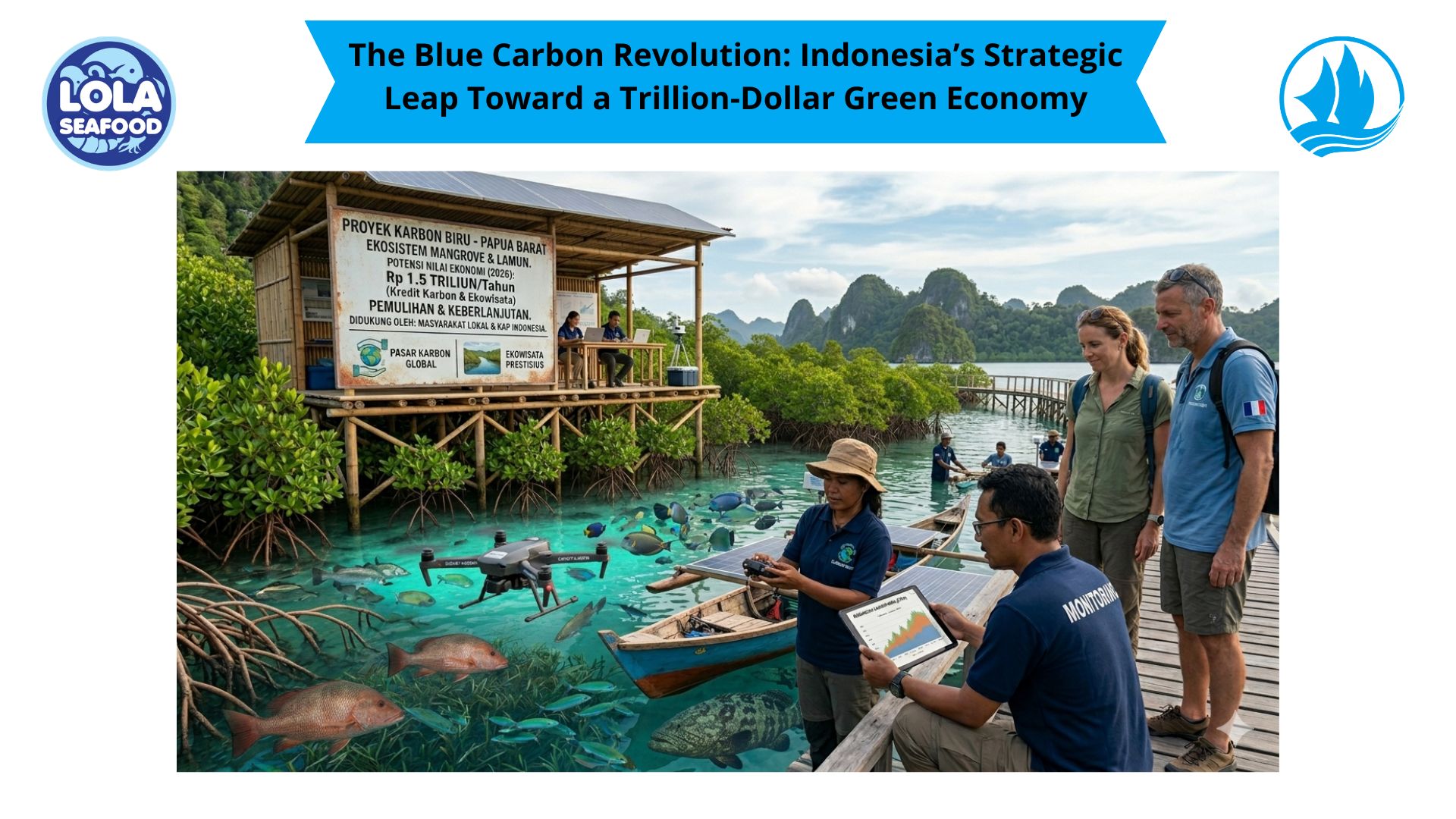
kelolalaut.com As the global community accelerates its transition toward a net-zero future in 2026, the traditional definitions of economic wealth are being rewritten. For decades, a nation’s prosperity was measured by its industrial output or mineral reserves. Today, a new asset class has emerged from the depths of the ocean: Blue Carbon. For Indonesia, the world’s largest archipelagic nation, this represents a golden opportunity to transform environmental stewardship into a massive economic engine.
Understanding the Blue Carbon Asset
Blue carbon refers to the carbon dioxide captured and stored by the world’s ocean and coastal ecosystems. While terrestrial forests often get the spotlight, coastal ecosystems—specifically mangroves, seagrass meadows, and salt marshes—are the unsung heroes of climate mitigation. Research indicates that these "blue" forests can sequester carbon at rates up to ten times higher per hectare than mature upland tropical forests.
Indonesia sits on a literal gold mine of these ecosystems. With over 3.3 million hectares of mangroves (representing approximately 20% of the world’s total) and vast seagrass beds, the archipelago is estimated to store roughly 3.4 gigatons of carbon (GtC). In the context of 2026, where the global carbon credit market is projected to skyrocket, these biological reserves are no longer just ecological features—they are high-value financial assets.
The Economic Mechanics: Turning Nature into Capital
The primary vehicle for this economic boost is the Carbon Credit Market. As multinational corporations face stricter regulations and pressure from shareholders to neutralize their carbon footprints, the demand for high-quality, verifiable carbon offsets has reached a fever pitch.
1. Revenue Generation through Carbon Trading
By quantifying the amount of carbon stored in protected or restored coastal areas, Indonesia can issue carbon credits. In 2026, as the price per ton of high-quality carbon offsets stabilizes between US$30 and US$80, the potential revenue for Indonesia is staggering. Effective management of these ecosystems could generate billions of dollars in annual revenue, providing the government with significant non-tax state revenue (PNBP) to fund national development.
2. Diversifying the "Blue Economy"
The Blue Carbon economy does not exist in a vacuum; it creates a "multiplier effect" across other sectors:
- Sustainable Fisheries: Healthy mangroves act as nurseries for demersal fish and shrimp. By protecting these habitats for carbon credits, the nation simultaneously boosts its fishery export value.
- Eco-Tourism: Restored coastal ecosystems become prime destinations for high-end, low-impact tourism. Travelers in 2026 are increasingly seeking "nature-positive" experiences, willing to pay a premium for destinations that prioritize conservation.
- Biotechnology: These biodiverse areas are hotspots for marine genetic resources, opening doors for pharmaceutical and biotechnological innovations.
Strategic Implementation: The 2026 Framework
To capitalize on this potential, Indonesia has implemented several strategic shifts. The focus has moved from "exploitation" to "value-added conservation."
Economic Insight: The Indonesian government’s 2026 "Blue Halo" policy integrates marine protection with economic incentives, ensuring that local coastal communities are the primary beneficiaries of carbon sales, rather than just international intermediaries.
Key Success Factors
|
Strategy |
Impact |
|
Digital MRV Systems |
Using AI and satellite imagery to provide "Monitoring, Reporting, and Verification" (MRV) ensures that carbon credits are transparent and fraud-proof. |
|
Community Ownership |
Granting "Social Forestry" permits to coastal villages allows them to manage mangroves and sell carbon credits directly to the market. |
|
Domestic Carbon Exchange |
The maturity of the Indonesia Carbon Exchange (IDXCarbon) allows for efficient price discovery and domestic trading before credits are exported. |
Challenges and Navigating the Risks
Despite the optimism, the path to a Blue Carbon superpower is not without hurdles. Climate change itself poses a threat, as rising sea levels can drown mangroves or alter the salinity of seagrass beds. Furthermore, "Greenwashing" remains a concern; Indonesia must maintain the highest standards of ecological integrity to ensure its credits remain "premium" in the eyes of global buyers.
There is also the challenge of land-use conflict. Converting coastal areas into carbon sinks often competes with the immediate economic needs of shrimp farming or infrastructure development. Balancing these interests requires a sophisticated spatial planning approach that prioritizes long-term sustainable yield over short-term extractive gains.
The Road to 2045
As we look toward the "Indonesia Emas" (Golden Indonesia) vision of 2045, Blue Carbon stands out as a pillar of resilience. It offers a way to decouple economic growth from environmental destruction. By 2026, the infrastructure for this market has been laid, and the first major payouts are reaching local communities, proving that a standing mangrove is worth significantly more than a cleared one.
If youre interested in our Whiting Fish Whole Round,Barramundi Fillet Skin On,Catfish Fillet Skinless,Cobia Fillet Skinless,Coral Trout Fillet Skin On,Barramundi Whole Round / Whole Gilled Gutted Scaled,Corvina / Croaker / Jew Fish Whole Round / Whole Gilled Gutted Scaled,Black Pomfret Whole Round,Red / Scarlet Snapper Fillet Portion,Parrotfish Fillet Skinless,Baby Octopus Flower please do not hesitate to contact us through email and/or Whatsapp
 Standards in Modern Seafood Processing.jpg)

.jpg)