Ensuring Excellence: A Guide to Selecting High-Quality, Non-Milky Fish for Industrial Processing
By. Lutfi - 08 Apr 2026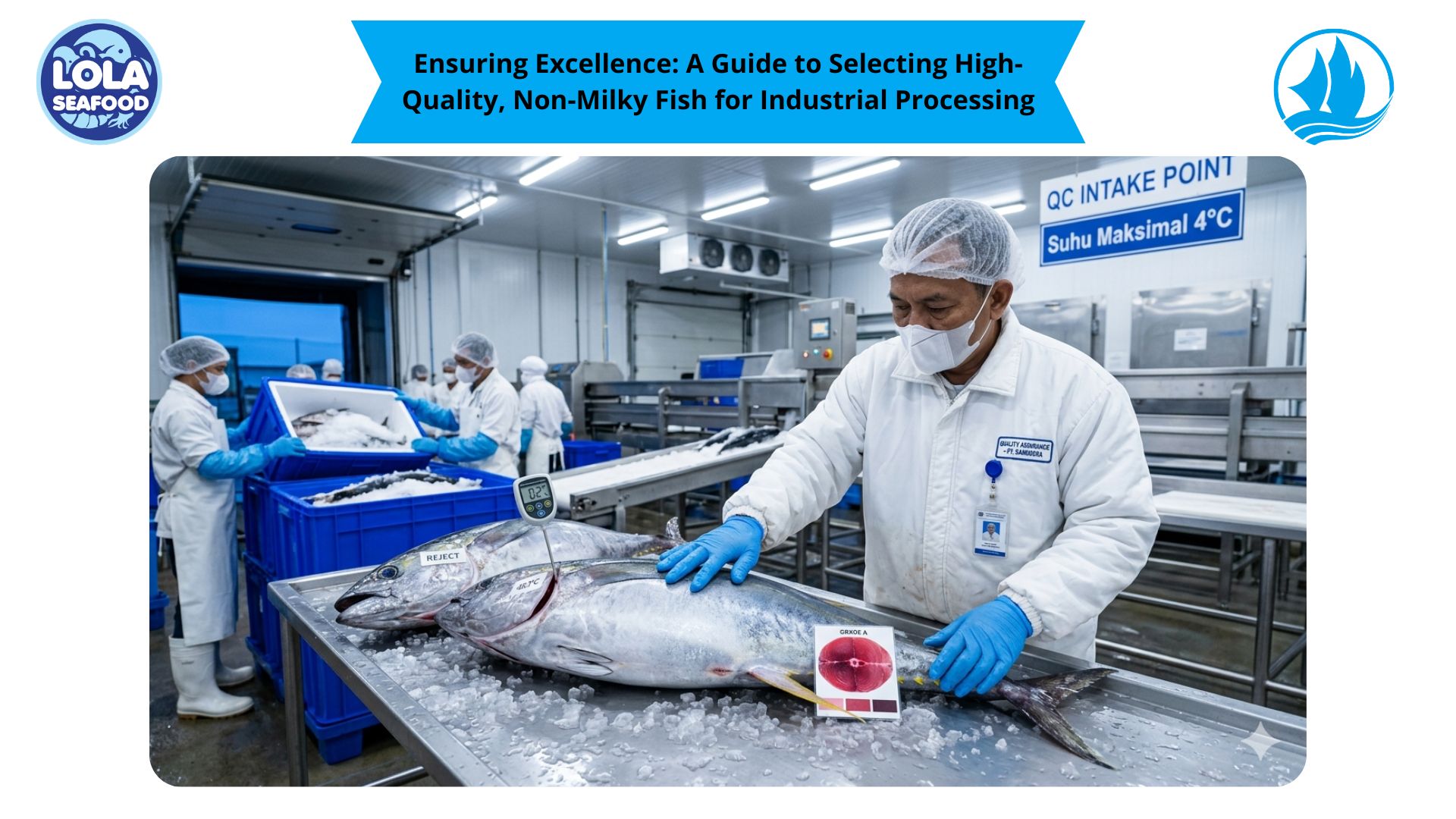
kelolalaut.com The success of a fish processing operation is determined long before the first fillet is cut or the first can is sealed. In the industrial sector, the mantra "quality in, quality out" is the absolute law. One of the most significant challenges quality control officers face is identifying fish that are not only fresh but also free from textural defects—most notably the dreaded "milky" or "mushy" flesh syndrome.
Selecting the right raw material requires a blend of sensory expertise, biological understanding, and rigorous adherence to cold chain standards.
Understanding the "Milky" Fish Phenomenon
Before diving into selection techniques, it is crucial to understand what causes "milky" fish. This condition, often seen in species like swordfish, tuna, and various whitefish, is frequently caused by Myxosporean parasites. These microscopic organisms release enzymes after the fish dies, which liquefy the muscle tissue.
To the naked eye, the fish might look acceptable on the outside, but once sliced, the flesh appears opaque, white, and loses its structural integrity, turning into a soft, paste-like consistency when cooked. For the processing industry, this is a disaster; it ruins yield, destroys mouthfeel, and can lead to massive product recalls.
Key Indicators of Premium Raw Material
To anticipate and prevent poor-quality intake, procurement specialists must focus on three primary pillars: Sensory Evaluation, Biochemical Markers, and Temperature History.
1. The Sensory Gold Standard
The first line of defense is always the human senses. While industrial labs exist, the speed of a loading dock requires rapid assessment:
- The Eyes: Look for clarity. The eyes should be convex (bulging) with a crystal-clear cornea and a deep black pupil. Cloudy or sunken eyes are an immediate red flag for aging or temperature abuse.
- The Gills: They should be a vibrant, bright red or pink. Avoid fish with brownish, gray, or slimy gills, as these indicate bacterial growth and oxidative stress.
- The Skin and Slime: High-quality fish should have a natural metallic luster. The slime layer should be transparent and aqueous, not thick, yellow, or clotted.
- Flesh Elasticity: When pressed with a finger, the flesh should spring back immediately. If a permanent indentation remains, the protein structure is already breaking down.
2. Identifying Potential "Milkiness"
Detecting parasites or enzymatic breakdown in whole fish is difficult but not impossible.
- Visual Slits: In many industrial settings, a small "tester" cut is made near the tail. If the flesh appears unusually white or exudes a cloudy liquid, the batch is likely infected with Myxosporea.
- PH Testing: The acidity of the fish muscle is a tell-tale sign. Ideally, post-rigor fish should have a pH around 6.0 to 6.4. If the pH drops too low or remains too high, it indicates stress during capture, which accelerates muscle degradation.
The Role of Post-Harvest Handling
Even the healthiest fish can turn "milky" or poor quality if handled incorrectly. In the industrial context, the Cold Chain is the most critical variable.
- Bleeding and Gutting: Rapidly removing the blood and viscera reduces the microbial load and prevents internal enzymes from migrating into the muscle.
- The "Deep Chill": Fish should be brought down to $0^{\circ}C$ (using slurry ice or refrigerated seawater) as soon as they are hauled on board. Slow cooling allows enzymes to remain active, increasing the risk of textural softening.
- Avoiding "Burnt" Flesh: In high-activity fish like Tuna, the struggle during capture can raise their body temperature significantly, essentially "cooking" the meat from the inside. This is known as Yake-niku or burnt tuna, which results in a pale, sour, and mushy texture.
Strategic Procurement and Quality Assurance
For an industrial processor, anticipating quality issues means building a robust relationship with the supply chain.
|
Feature |
High-Quality Grade |
Rejected / Low Grade |
|
Odour |
Fresh, sea-like, neutral |
Amonical, sour, or "fishy" |
|
Texture |
Firm, resilient, translucent |
Soft, grainy, opaque/milky |
|
Gills |
Bright red, no odour |
Brown, mucousy, foul smell |
|
Yield Potential |
High; holds shape during slicing |
Low; disintegrates during processing |
Modern processing plants are now incorporating Near-Infrared (NIR) Spectroscopy and Ultrasound to detect parasites and fat content without damaging the fish. While expensive, these tools provide a non-destructive way to ensure that "milky" fish never reach the production line.
If youre interested in our Whiting Fish Whole Round,Barramundi Fillet Skin On,Catfish Fillet Skinless,Cobia Fillet Skinless,Coral Trout Fillet Skin On,Barramundi Whole Round / Whole Gilled Gutted Scaled,Corvina / Croaker / Jew Fish Whole Round / Whole Gilled Gutted Scaled,Black Pomfret Whole Round,Red / Scarlet Snapper Fillet Portion,Parrotfish Fillet Skinless please do not hesitate to contact us through email and/or Whatsapp
.jpg)

.jpg)




.jpg)